9 Best Thermometers for Bread Dough (November 2026)
The best thermometers for bread dough include the TempPro TempSwift TP19H 1 Sec Instant Read for fast dough checks, the ThermoMaven 0.5 Sec Professional Meat Thermometer Digital for certified accuracy, and the Lavatools Javelin® PRO Classic Ultra-Fast 2-Second Professional for frequent baking sessions.
On this page (8 sections)
- The best thermometers for bread dough
- What makes a good bread dough thermometer?
- How do you measure bread dough temperature?
- Which thermometer is best for deep dough bowls?
- Which display and storage features help bakers?
- How should you clean and store a bread dough thermometer?
- Are digital or analog thermometers better for bread dough?
- Best thermometer for bread dough: the final choice
The best thermometer for bread dough is the TempPro TempSwift TP19H 1 Sec Instant Read because it combines a 1-second reading, a 4.3-inch stainless steel probe and a large auto-rotating backlit display.
It suits bakers who check dough during mixing, fermentation, proofing and shaping without waiting for a slow reading.
ThermoMaven is the accuracy-focused alternative, while LONICERA is a useful choice for sourdough fermentation.
Dough temperature affects how quickly fermentation moves, but the target still comes from your recipe and method.
A thermometer does not replace the recipe. It gives you a number to compare with the target, then you can adjust expectations for rise and timing.
That is the practical value when the kitchen is cold, warm, or somewhere in between.
To monitor oven temperature instead, see digital oven thermometers with probes.
Oven air and dough temperature are related, but they answer different questions during a bake.
A thermometer helps you check dough directly instead of guessing from room temperature alone.
Room temperature can feel comfortable while dough inside a bowl stays cooler, especially after cold flour, cold water, or a cold mixing bowl.
Before choosing, consider probe length, reading speed, display visibility, cleaning needs and whether you also want to measure liquids or baked food.
A home baker who only checks dough needs different things from someone who also measures water, milk, candy, or cooked food.
Our baking measuring tools guide covers other tools that help keep bread formulas consistent.
A thermometer works best when scale, cups, bowls, and mixing routine are also steady from batch to batch.
For everyday dough work, a fast reading matters because you can check the center, record the number, and keep moving.
A backlit rotating display matters when your hands are wet, floured, or busy, and numbers would otherwise face away from you.
Cleaning matters too, because dough residue can build up quickly and a probe should be cleaned before and after each check.
The TP19H earns the top spot because its stated speed, probe length, display size, and calibration function cover the main needs of most home bakers.
Our picks at a glance
-
1
 Best for fast dough checks
TempPro TempSwift TP19H 1 Sec Instant Read
9.7/10 our score
See it on Amazon -
2
 Best for certified accuracy
ThermoMaven 0.5 Sec Professional Meat Thermometer Digital
9.6/10 our score
See it on Amazon -
3
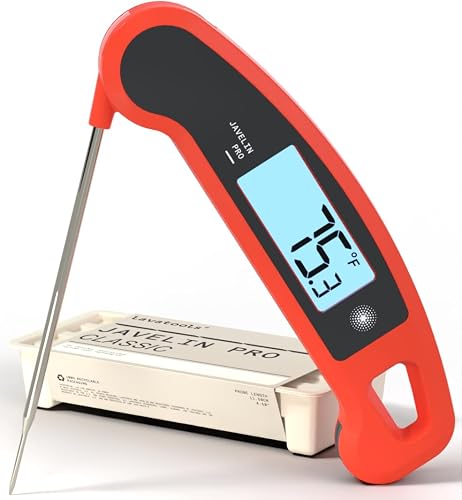 Best for frequent baking sessions
Lavatools Javelin® PRO Classic Ultra-Fast 2-Second Professional
9.5/10 our score
See it on Amazon
- 4
 Check it
TempPro TempSwift 1 Sec Meat Thermometer Digital
Best for deep dough bowls - 5
 Check it
Alpha Grillers Meat Thermometer Digital
Best for all-purpose baking - 6
 Check it
LONICERA Digital Cooking Thermometer
Best for sourdough fermentation - 7
 Check it
Lavatools Javelin® Ultra-Fast 3-Second Digital Instant Read
Best for compact storage - 8
 Check it
Alpha Grillers Instant Read Meat Thermometer Digital
Best for simple bread checks - 9
 Check it
Rubbermaid Commercial Products Food/Meat Thermometer
Best for battery-free simplicity
The best thermometers for bread dough
The best bread dough thermometer depends on how often you bake and how much dough you mix. A baker who makes one loaf each week has different needs from someone who mixes several batches on a regular schedule.
The top picks favor fast readings and easy viewing, while the lower-scoring options trade speed or precision for compact storage or simple operation. That trade-off is not a flaw, because a compact tool can suit a small kitchen better than a larger one.
Our score weighs stated specs, features and buyer feedback against what you're shopping for. We compared the product information for probe reach, speed, accuracy, display design, cleaning and dough-related use.
Probe reach decides whether you can check the center of a deep batch without scraping the bowl. Speed decides how long the probe stays in the dough, and display design decides whether you can read the number while your hands are busy.
Accuracy and resolution help you judge how much trust to place in a small difference between batches. Cleaning and storage decide whether the tool is easy to keep ready near the mixer or prep area.
For frequent bakers, fast readings and a clear display usually earn their place because checks happen often. For occasional bakers, a simpler or more compact thermometer may be easier to store and use without fuss.
The lower-scoring options in this list are still food thermometers with useful stated features for dough and other kitchen checks. Their position reflects the balance of the whole list, not a claim that they cannot check dough temperature.
Read the product summaries with your own routine in mind, especially batch size, bowl depth, and how often you check during fermentation. The best choice is the one you will actually use each time you mix dough.
| Product | Best for | Response time | Probe | Display | Our score |
|---|---|---|---|---|---|
| TempPro TempSwift TP19H 1 Sec Instant Read | fast dough checks | 1 second | 4.3 inches, food-grade stainless steel | 2-inch, 180° auto-rotating backlit display | 9.7 |
| ThermoMaven 0.5 Sec Professional Meat Thermometer Digital | certified accuracy | 0.5 seconds | 9.6 | ||
| Lavatools Javelin® PRO Classic Ultra-Fast 2-Second Professional | frequent baking sessions | 2 seconds | 2-inch, 180° auto-rotating backlit display | 9.5 | |
| TempPro TempSwift 1 Sec Meat Thermometer Digital | deep dough bowls | 5.3 inches | 9.4 | ||
| Alpha Grillers Meat Thermometer Digital | all-purpose baking | 1 to 2 seconds | 9.3 | ||
| LONICERA Digital Cooking Thermometer | sourdough fermentation | 5.1 inches | 8.9 | ||
| Lavatools Javelin® Ultra-Fast 3-Second Digital Instant Read | compact storage | 3 seconds | 2.75 inches | 8.8 | |
| Alpha Grillers Instant Read Meat Thermometer Digital | simple bread checks | 2 to 3 seconds | 8.3 | ||
| Rubbermaid Commercial Products Food/Meat Thermometer | battery-free simplicity | Analog | 8.1 |
TempPro TempSwift TP19H 1 Sec Instant Read: Best for fast dough checks
- 1-second readings
- ±0.9°F accuracy
- 4.3-inch food-grade stainless steel probe
- 2-inch auto-rotating backlit display
The TP19H combines a 1-second reading with a 4.3-inch stainless steel probe and a large rotating display. Its lock and calibration functions suit bakers who check dough during mixing and fermentation.
Pros
- Fast readings
- Long stainless steel probe
- Backlit rotating display
- IP65 waterproof design
Cons
- Requires hand washing
- The title and product data describe it as a meat thermometer
ThermoMaven 0.5 Sec Professional Meat Thermometer Digital: Best for certified accuracy
- 0.5-second readings
- ±0.5°F NIST-certified accuracy
- IP67 waterproof design
- Auto-rotating backlit display
ThermoMaven is the most precise choice here by its stated accuracy. Its fast probe, rotating display and waterproof design make repeated dough checks easier.
Pros
- Fastest stated response time
- NIST-certified accuracy
- IP67 waterproof design
- Magnet and hanging hook
Cons
- Plastic outer material
- The title and product data describe it as a meat thermometer
Lavatools Javelin® PRO Classic Ultra-Fast 2-Second Professional: Best for frequent baking sessions
- 2-second response time
- ±0.5°F achievable by laboratory calibration
- 2-inch auto-rotating backlit display
- IP65 water-resistant design
The Javelin PRO Classic gives bakers a large rotating display, motion activation and a stated battery life of 4000 hours. It is a strong fit when temperature checks are part of a regular baking routine.
Pros
- Large rotating display
- Long stated battery life
- NSF certified
- IP65 water resistance
Cons
- Wipe-clean care rather than running-water cleaning
- Probe length is listed as 10.75 inches for immersion depth
TempPro TempSwift 1 Sec Meat Thermometer Digital: Best for deep dough bowls
- 1-second reading
- 5.3-inch food-grade stainless steel probe
- Temperature range from -58°F to 572°F
- Celsius and Fahrenheit selector
The 5.3-inch probe reaches farther into a deep mixing bowl or large dough batch. Its 1-second reading and Fahrenheit/Celsius selector keep routine checks simple.
Pros
- Longest stated probe
- Fast reading
- Wide temperature range
- Probe tip cover
Cons
- No backlit display is stated
- The product data gives a 5-second response time in the specifications
Alpha Grillers Meat Thermometer Digital: Best for all-purpose baking
- 1 to 2-second response time
- IP67 waterproof design
- Bright blue backlight
- Pre-calibrated with recalibration feature
Alpha Grillers works for dough, liquids, candy and cooked food, so it suits a kitchen that wants one general thermometer. The bright blue backlight helps with low-light readings.
Pros
- Multi-use design
- Fast response
- IP67 waterproof rating
- Recalibration feature
Cons
- Hand wash only
- The product data does not state probe length
LONICERA Digital Cooking Thermometer: Best for sourdough fermentation
- 5.1-inch food-grade probe
- 1-second reading claim
- ±1°F accuracy
- IP67 waterproof design
LONICERA is made with dough temperature in mind, including sourdough fermentation and proofing. Its 5.1-inch probe, hold button and built-in magnet suit repeated checks around the kitchen.
Pros
- Long probe
- Sourdough-focused use
- Backlit display
- IP67 waterproof design
Cons
- Accuracy is ±1°F
- The listed resolution is 1°C or 2°F
Lavatools Javelin® Ultra-Fast 3-Second Digital Instant Read: Best for compact storage
- 3-second response time
- 2.75-inch probe
- Compact foldable design
- 1.4-inch display
The compact Javelin has a 2.75-inch probe and foldable design for bakers with limited drawer space. Its smaller probe is better for shallow dough portions than deep bowls.
Pros
- Compact foldable design
- 4000-hour stated battery life
- IP65 water resistance
- NSF certified
Cons
- Shorter probe than several picks
- Smaller 1.4-inch display
Alpha Grillers Instant Read Meat Thermometer Digital: Best for simple bread checks
- 2 to 3-second response time
- Bright blue backlight
- IP66 water-resistant design
- Instructions and battery included
This Alpha Grillers model covers basic dough and bread temperature checks with a backlit display and a stated 2 to 3-second response time. It suits occasional bakers who want a simple digital probe.
Pros
- Backlit display
- Instructions included
- Battery included
- Water-resistant design
Cons
- IP66 rather than IP67
- Shorter stated probe depth than several picks
Rubbermaid Commercial Products Food/Meat Thermometer: Best for battery-free simplicity
- Mechanical dial
- 0°F to 200°F range
- 2-degree resolution
- Stainless steel construction and protective sheath
Rubbermaid offers a simple mechanical option with no battery requirement, a 5-inch stainless steel probe and a protective sheath. Its slower reading and 2-degree increments make it less precise for fine dough-temperature control.
Pros
- No battery required
- Stainless steel construction
- Dishwasher safe
- NSF certified
Cons
- Analog display
- 2-degree resolution
- 5-second response time
What makes a good bread dough thermometer?
A good thermometer for bread dough should give a stable reading quickly and reach the center of the dough.
If it is slow, you may be tempted to skip checks, and if it is short, you may read a spot near the surface instead of the middle.
If you mix dough with an electric mixer, see mixing bowls for electric mixers.
Bowl depth and mixer use affect how far the probe needs to travel and how you hold the thermometer while checking.
A clear display also matters because dough checks often happen beside a mixer, bowl or warm proofing area.
You may be holding the bowl, steadying dough, or working with floured hands, so numbers should be easy to read at a glance.
Probe length is the first practical choice.
A 2.75-inch probe can suit smaller dough portions, while the 4.3-inch TempPro, 5.1-inch LONICERA and 5.3-inch TempPro reach farther into deeper bowls.
A longer probe is not automatically better for every batch, because a small dough portion may be easier to check with a shorter probe.
Reading speed matters when you want to check dough without leaving the mixer or exposing it to the room for long.
ThermoMaven states a 0.5-second response time, while the fastest TempPro and LONICERA models state 1-second readings.
Speed also matters for repeated checks, such as after mixing and again during fermentation when the rise seems fast or slow.
Accuracy and resolution are related but not identical.
ThermoMaven states ±0.5°F accuracy, while the TP19H states ±0.9°F accuracy and 0.1°F/0.1°C resolution.
Accuracy describes how close the reading is expected to be, while resolution describes the smallest step shown on the display.
A finer display step can help you spot small changes, but it does not erase the limits of the stated accuracy.
Cleaning is another practical point, because dough can leave residue on the probe and the area near the tip.
A waterproof rating can make rinsing easier, but care instructions still decide how each model should be washed.
Storage matters as well, since a thermometer kept near the prep area is more likely to be used.
A magnet, hanging hole, tip cover, or protective sheath can protect the probe and keep the tool within reach.
Battery life and sleep behavior also affect daily use, especially if the thermometer sits in a drawer between baking days.
The best dough thermometer is therefore not only the fastest or the longest, but the one whose probe, display, cleaning, and storage fit your mixing routine.
How do you measure bread dough temperature?
To measure bread dough temperature, insert the clean probe into the center of the dough and wait for the reading to settle. Clean hands and a clean probe keep the check simple, and the center gives a more useful number than the surface.
Avoid touching the bowl, mixer hook or work surface because those can affect the result. The bowl may be warm from the room, cold from the fridge, or heated by mixing, so contact with it can pull the reading away from the dough itself.
Check the dough after mixing if your recipe gives a target temperature. That first check tells you where the batch starts, and it helps you judge whether fermentation may move faster or slower than expected.
If the reading is outside the target, you can use the information to adjust fermentation expectations rather than changing the dough without a plan. A number gives you a reason to wait, watch, or plan the next check at a better time.
For a broader food-safety workflow, see how to use a thermometer for food. That workflow covers general habits for checking food temperature, while dough checks focus on matching the recipe target.
For digital probe technique, our guide to how to use an instant read thermometer explains placement and reading habits. Good placement matters for dough too, because the center of the batch is more representative than an edge.
A lock function can help when the display is hard to view while you hold the bowl. Locking the number lets you remove the probe, look at the reading calmly, and record it without rushing.
The TP19H and LONICERA include temperature-lock features, while auto-rotating displays on the TP19H, ThermoMaven and Javelin PRO Classic help keep numbers facing you. Those features are small details, but they make repeated checks easier when your hands are busy.
It also helps to check dough at consistent points, such as after mixing and during fermentation when the rise looks unusual. Writing down the number, room conditions, and batch size can make future batches easier to compare.
Avoid pushing the probe so far that it scrapes the bowl or presses against a hard surface. A steady hand, a clean probe, and a little patience usually give a more useful reading than a rushed check.
Once the reading is recorded, clean the probe before it goes back into storage. That habit protects the tip, keeps the tool ready for the next batch, and keeps dough residue from building up over time.
Which thermometer is best for deep dough bowls?
The TempPro TempSwift 1 Sec Meat Thermometer Digital is the strongest pick for deep dough bowls because its stated 5.3-inch probe reaches farther into a large batch.
LONICERA follows with a 5.1-inch probe, while the TP19H has a 4.3-inch probe.
Depth matters when dough fills a large mixing bowl, because the center of the batch can sit well below the surface.
A longer probe lets you reach that center without leaning over the bowl or pressing the body of the thermometer into the dough.
A long probe is useful only if you can insert it safely and clean it thoroughly afterward.
Push the tip into the dough center without scraping the bowl, then wash the probe according to the thermometer's care instructions.
Scraping the bowl can scratch the surface and can also push the tip toward a hard edge instead of the dough center.
A slow, steady insertion is safer for both the bowl and the probe.
The longer probes also make these models useful for liquids.
If you often measure water, preferments or other thin mixtures, compare them with our guide to the best instant read thermometers for liquids.
Liquids in a deep container present the same reach problem as dough in a deep bowl, so probe length helps in both cases.
A probe that reaches the middle of the container gives a more useful reading than one that stays near the top.
For large batches, a long probe can also help when you check dough after it has spread out in the bowl.
The center may shift as the dough relaxes, so reaching inward matters more than checking the same surface spot.
Hand position matters too, because a longer probe keeps your fingers farther from warm liquid or a busy mixer.
That extra distance is a practical benefit, especially when the bowl is deep and the display needs to stay visible.
Cleaning a long probe takes a little more care, since dough can cling along more of its length.
Rinsing or wiping the full probe area, as the care instructions allow, keeps the tool ready for the next check.
Storage should protect the tip when the thermometer is not in use.
A tip cover, sheath, magnet, or hanging spot can keep a long probe from bending, scraping, or collecting residue in a drawer.
If your dough batches are usually small, the longest probe may be more than you need, and a shorter probe may be easier to place.
For deep bowls and large batches, however, the 5.3-inch and 5.1-inch probes give you reach that a shorter model cannot match.
Which display and storage features help bakers?
A large backlit display helps when your hands are busy or the kitchen is dim. The TP19H and Javelin PRO Classic each have a 2-inch display, while the compact Javelin has a 1.4-inch display.
Display size matters most at the moment you check the dough, when you may be holding a bowl or standing beside a mixer. A larger display makes the number easier to read without turning the thermometer or moving closer to a light source.
Auto-rotation is useful for left-handed and right-handed use. A magnet or hanging hook also keeps the thermometer close to the mixer, refrigerator or baking area without leaving it on a wet counter.
Auto-rotation helps because the reading can face you from different angles as you hold the probe. That matters when the dough bowl is large, the counter is crowded, or you need to check from the side rather than the front.
A magnet is useful on a refrigerator or another metal surface near the prep area. A hanging hook works well on a rail or hook where the probe can stay protected and easy to grab.
Storage is not a minor detail for bakers, because flour and dough residue can spread across counters and drawers. Keeping the thermometer in a fixed spot helps you avoid leaving it on a wet surface or among mixing tools.
For a general fast-reading comparison, see the best fastest instant read thermometer. That comparison focuses on speed across food uses, while bread dough checks also depend on probe length and display position.
For bread baked after proofing, an oven thermometer for bread baking answers a different question because it measures oven air rather than dough temperature. Dough temperature guides fermentation, while oven temperature guides the bake itself.
Backlighting helps in low light, but it does not replace a clear display or a steady hold on the probe. The best display is the one you can read quickly while the probe is still in the dough.
Compact storage can be a better fit for a small kitchen than a large display, even if the numbers are smaller. The compact Javelin trades display size for easier storage, which can matter if drawer space is limited.
Think about where the thermometer will live between checks, not only how it looks in your hand. A tool that stays near the mixer, fridge, or proofing area is more likely to be used before every batch.
How should you clean and store a bread dough thermometer?
Clean the probe before and after every dough check, then follow the care instructions for the model. Waterproof ratings can make rinsing easier, but they do not mean every thermometer should be submerged or placed in a dishwasher.
Dough residue can dry quickly, so cleaning soon after a check is easier than leaving the probe until later. Warm water and a gentle wash, as allowed by the care instructions, should remove flour and dough from the probe area.
The TP19H has an IP65 waterproof design and hand-wash care instructions. ThermoMaven and Alpha Grillers have higher stated water-resistance ratings, while Rubbermaid is dishwasher safe.
Those differences matter at the sink, because a model that allows rinsing is easier to clean after sticky dough than one that should only be wiped. Always check the care instructions for the exact model rather than relying on the rating alone.
Keep the probe protected when it is stored. The TempPro TempSwift 1 Sec includes a probe tip cover, Rubbermaid includes a protective sheath, and several digital models use a magnet or hanging feature for storage.
A cover or sheath protects the tip from bumps and keeps it away from other tools. A magnet or hanging spot keeps the thermometer off a wet counter and within reach of the mixing area.
If the thermometer becomes hard to read or gives unusual results, check its battery and calibration options. A dim display often points to battery life, while a sudden change in readings can raise a question about calibration.
The TP19H includes a calibration function, Alpha Grillers includes a recalibration feature, and ThermoMaven includes calibration certification. Those features do not replace good technique, but they can help you check whether the tool still reads as expected.
Store the thermometer in a dry place where the probe will not bend or scrape against other items. A drawer divider, hanging spot, or magnetic spot can work well if it keeps the tip protected.
Avoid leaving the probe in dough, water, or a hot bowl while you do other tasks. Removing it promptly makes cleaning easier and reduces the chance of damage to the tip or display.
A simple routine works best, with cleaning before the check, cleaning after the check, and protected storage until the next batch. That routine keeps the thermometer ready, clean, and easy to use whenever dough temperature needs checking.
Are digital or analog thermometers better for bread dough?
Digital thermometers are usually easier for bread dough because they give faster readings and clearer temperature changes. For another instant-read option, see our Weber thermometer review.
A digital display can show small changes between checks, which helps when you compare batches or watch fermentation over time. Backlighting, auto-rotation, and a lock function can also make the reading easier to capture while your hands are busy.
The Rubbermaid Commercial Products thermometer is the analog exception, with a battery-free mechanical design and 2-degree resolution. Its dial reads in larger steps, so it will not show the same fine changes as a digital model.
Choose Rubbermaid if you prefer a simple tool that does not need battery changes. Choose a digital model if you want backlighting, a lock function, a Celsius/Fahrenheit selector or readings in smaller displayed increments.
The analog option can still check dough temperature, especially when you only need a general reading. Its simplicity can suit a baker who wants a tool that is always ready without a battery to maintain.
Digital models vary in probe length, response time, and display size, so the digital category is not one single choice. A compact digital model may suit a small kitchen, while a long-probe digital model may suit a deep bowl.
For most dough recipes, consistent technique matters as much as the thermometer. Insert the probe into the same part of the dough each time, avoid the bowl and record the reading when you are adjusting future batches.
Consistency matters because a reading from the center of one batch is not directly comparable with a reading from the edge of another batch. The same placement, similar batch size, and similar timing make the numbers more useful.
Battery care is also part of the digital choice, since a weak battery can make the display hard to read. Checking the battery before a baking session can prevent a slow or dim reading when you need a quick check.
Analog simplicity has its own appeal, because there is no display to power and no battery to replace. The trade-off is coarser resolution and a dial that may be harder to read in low light.
Choose based on how closely you want to track dough temperature from batch to batch. If small differences matter to your routine, a digital model is usually the easier fit, and if simplicity matters most, the analog option still has a clear place.
Best thermometer for bread dough: the final choice
The TempPro TempSwift TP19H 1 Sec Instant Read is the best thermometer for bread dough for most home bakers. Pick it for fast readings, a 4.3-inch stainless steel probe, a large rotating backlit display and calibration support.
That combination covers the main moments of a bake, from the check after mixing to later checks during fermentation. It is a practical all-around choice when you want speed, reach, and easy viewing in one tool.
Choose ThermoMaven for its stated ±0.5°F NIST-certified accuracy. Choose the 5.3-inch TempPro for deep bowls, LONICERA for sourdough fermentation, the compact Javelin for drawer storage, or Rubbermaid for a battery-free analog tool.
Each alternative answers a narrower need, so match the pick to your batch size, storage space, and checking habits. The TP19H remains the balanced choice for most bakers, while the others are strong picks when one feature matters most.
Our top 3 picks at a glance
-
1
Best for fast dough checks
TempPro TempSwift TP19H 1 Sec Instant Read
9.7/10 our score
See it on Amazon -
2
Best for certified accuracy
ThermoMaven 0.5 Sec Professional Meat Thermometer Digital
9.6/10 our score
See it on Amazon -
3
Best for frequent baking sessions
Lavatools Javelin® PRO Classic Ultra-Fast 2-Second Professional
9.5/10 our score
See it on Amazon
Frequently asked questions
What is the best thermometer for bread dough?
The TempPro TempSwift TP19H is the best thermometer for bread dough for most bakers because it combines a 1-second reading, a 4.3-inch stainless steel probe and a 2-inch rotating backlit display.
Choose ThermoMaven if stated ±0.5°F NIST-certified accuracy matters most, or LONICERA if you mainly check sourdough during fermentation.
What temperature should bread dough be?
The right dough temperature depends on the recipe, flour, yeast and fermentation plan. Use the recipe's target rather than applying one number to every loaf.
Measure in the center of the dough after mixing, then check again during fermentation if the rise seems faster or slower than expected.
Can you use a meat thermometer for bread dough?
Yes. An instant-read meat thermometer can measure bread dough if its probe reaches the dough center and you clean it before and after use.
The TempPro, ThermoMaven, Lavatools and Alpha Grillers models here are digital probe thermometers designed for food temperature checks, so they can also suit dough.
How deep should a thermometer go into bread dough?
Push the probe far enough to reach the center without touching the bowl. A probe between about 2.75 and 5.3 inches can work, depending on batch size and container depth.
For small dough portions, a shorter probe may be easier to place accurately.
For deep bowls, choose a longer probe.


