9 Best Precision Gram Scales (November 2026)
The best precision gram scales include the Etekcity 0.1g Food Kitchen Scale for all-around baking, the Fuzion Digital Pocket Scale for pocket precision, and the MAXUS Digital Milligram Scale 50g/0.001g for milligram weights.
On this page (8 sections)
- Best precision gram scales for yeast, salt and small baking weights
- How to compare precision gram scales side by side
- What readability do you need for yeast and salt?
- How much capacity do you need for dough and bowls?
- Can you measure grams with measuring cups?
- Which precision gram scale is best for bread baking?
- How do you set up and care for a precision gram scale?
- Verdict: which best precision gram scale should you buy?
The best precision gram scale for most bakers is the Etekcity 0.1g Food Kitchen Scale, because it covers 11 lb and still reads to 0.1g under 1000g. A best precision gram scale in the 0.01g or 0.001g class suits tiny yeast and salt weights better.
Our score weighs specs, features and buyer feedback against what you are shopping for. We compared capacity, readability, minimum weight, tare, units, size and included calibration parts.
We did not test them by hand.
You can learn basics in our guide on how to use a kitchen scale. That guide explains tare, units and stable placement in plain steps.
Accuracy at low weights depends on the sensor, the platform and the surface under the scale. A 0.01g readout means the display changes in 0.01g steps, not that every ingredient will read perfectly at 0.01g.
Minimum weight matters for the same reason. A scale that starts at 0.05g will struggle with a 0.02g pinch, even if the display looks fine.
Our picks at a glance
-
1

-
2

-
3
 Best for milligram weights
MAXUS Digital Milligram Scale 50g/0.001g
9.5/10 our score
See it on Amazon
- 4
 Check it
GGQ Food Scale -33lb Digital Kitchen Scale
Best for large batches - 5
 Check it
Weigh Gram Digital Milligram Scale 50g/0.001g High Precision
Best for tiny powder amounts - 6
 Check it
Toprime Digital Gram Scale 500g 0.01g Food
Best for 500g food weighing - 7
 Check it
Fuzion Digital Gram Scale .01 Gram Accuracy
Best for counting and tare - 8
 Check it
Cybergiant 13lb/0.1g Precision Digital Food Scale
Best for espresso and meal prep - 9
 Best for compact countersCheck it
Best precision gram scales for yeast, salt and small baking weights
The Etekcity leads for daily baking because its 11 lb range and removable bowl cover full dough batches. Pocket models from Fuzion, MAXUS and Weigh Gram lead when the job is under 500g.
The split between kitchen scales and pocket scales is the main buying choice here. Kitchen scales handle bowls and flour, while pocket scales handle yeast, salt, spices and coffee in small trays.
Etekcity 0.1g Food Kitchen Scale: Best for all-around baking
- 11 lb/5 kg capacity
- 0.1g increments under 1000g
- Removable bowl
- Backlit LCD display
A full-size kitchen scale with a detachable bowl for flour, dough and mixed ingredients, plus 0.1g reading for small additions.
Pros
- High capacity for dough
- Removable bowl for tare
- 0.1g readability under 1000g
Cons
- 1g steps above 1000g
- Not a milligram scale
The Etekcity suits bakers who want one scale for flour, dough, toppings and small additions in the same session. Its 11 lb/5 kg capacity covers a full mixing bowl, while 0.1g steps under 1000g help with salt, yeast and spices.
The removable bowl flips for storage and works as a cover, which saves drawer space. You can also weigh without the bowl when a container needs a flat platform.
Units include oz, lb, g, fl oz and mL, plus milk and water density modes for liquid recipes. The backlit LCD shows results clearly, and tare lets you add ingredients one by one in the bowl.
It reads instantly, and auto-off after 2 minutes helps preserve the two AAA batteries. Low battery and overload indicators warn you before a batch goes wrong.
Trade-off: above 1000g the steps change to 1g, so it is not a milligram tool. Choose a 0.01g pocket scale for weights under 20g.
Fuzion Digital Pocket Scale: Best for pocket precision
- 500g x 0.01g
- 50g calibration weight included
- 6 units
- Backlit LCD
A compact 500g pocket scale that reads to 0.01g and includes a 50g calibration weight for small baking and spice weights.
Pros
- 0.01g readability
- Calibration weight included
- Compact pocket size
Cons
- 500g limit
- Too small for dough bowls
The Fuzion pocket scale suits yeast, salt, spices and coffee doses under 500g. Its 500g x 0.01g readability gives finer steps than a 0.1g kitchen scale.
A 50g calibration weight is included, so you can recalibrate before precise work. Minimum weight is 0.05g and permissible error is plus or minus 0.03g.
The ABS housing has a rubberized grip and magnetic closure for carrying. Six units cover g, oz, gn, ct, dwt and ozt, and a large backlit LCD updates in about 1 second.
Tare subtracts a tray or container, while low battery, overload and unstable indicators warn you about poor conditions. The 180 second auto-off helps save battery life.
Trade-off: the 500g limit and pocket platform will not hold a dough bowl. Keep a larger kitchen scale for flour and dough.
MAXUS Digital Milligram Scale 50g/0.001g: Best for milligram weights
- 50g x 0.001g
- 2 x 20g weights
- USB and battery power
- Tray, tweezers and scoop
A 50g milligram scale for tiny powder, yeast and salt amounts where 0.001g readability helps you repeat a formula.
Pros
- 0.001g readability
- Two calibration weights
- Tray and scoop included
Cons
- 50g capacity only
- Needs careful setup
The MAXUS suits bakers who need milligram repeatability for very small powder amounts. Its 50g x 0.001g readability is ten times finer than 0.01g models.
Two 20g calibration weights, a USB cable, weighing tray, tweezers and scoop are included. The tray helps with loose powder, and the scoop helps transfer fine material.
Four buttons handle tare, counting, unit and power. You can run it on batteries or USB for desk use, and six units cover g, oz, ozt, dwt, ct and gn.
The 4.5 x 2.6 x 1.6 in size fits a desk or hobby table. Auto shut off and a backlit display help with repeated small weighing sessions.
Calibration follows a clear sequence with the 20g weights, which helps keep readings consistent. Counting mode also helps with small parts of uniform weight.
Trade-off: capacity stops at 50g, so flour and dough are out of range. It also needs level placement and calibration before use.
GGQ Food Scale -33lb Digital Kitchen Scale: Best for large batches
- 33 lb/15 kg capacity
- 1g graduation
- USB-C rechargeable
- Stainless steel panel
A large rechargeable food scale for big dough batches, with 1g steps from 3g upward and a 7.5 x 5.5 in panel.
Pros
- Very high capacity
- Rechargeable USB-C
- Large stainless panel
Cons
- 1g steps limit small weights
- Minimum useful weight is 3g
The GGQ suits large dough batches and bakers who weigh bowls, flour and add-ins in one step. Its 33 lb/15 kg capacity is the largest here.
The 7.5 x 5.5 in stainless panel gives room for larger containers. Tare subtracts a mug, plate or bowl so you read only the food.
It is USB-C rechargeable, with a 2 minute auto-off, low power alarm and overload reminder. Units include g, kg, lb:oz, oz and ml.
Four high precision load sensors support the 1g graduation from 0.1oz/3g upward. The waterproof glass panel is designed for kitchen splashes and daily mess.
A hanging hook and four non-slip rubbers help with storage and stability. Touch controls and an LCD display keep the surface simple to wipe clean.
Trade-off: graduation is 1g from 0.1oz/3g upward, so tiny yeast weights are less precise. Pair it with a pocket scale for small amounts.
Weigh Gram Digital Milligram Scale 50g/0.001g High Precision: Best for tiny powder amounts
- 50g x 0.001g
- 20g calibration weight
- Flip cover
- Backlit LCD
A pocket milligram scale with flip cover and 20g calibration weight for powder, yeast and other small dry weights.
Pros
- 0.001g readability
- Flip cover protects pan
- Calibration weight included
Cons
- 50g capacity only
- Pocket size limits containers
The Weigh Gram suits tiny powder, yeast and salt weights under 50g. Its 50g x 0.001g readability matches the MAXUS on fineness.
A 20g calibration weight is included, and the ABS flip cover protects the pan in a drawer. The backlit LCD helps in low light, and six modes cover g, oz, ozt, dwt, ct and gn.
Tare subtracts a tray or container, and auto-off works after 180 seconds. The body measures about 2.95 x 5.39 x 0.59 in, so it fits a pocket or small drawer.
Calibration uses the MODE key and the included 20g weight, with a PASS display when complete. That routine is simple enough to repeat before important powder work.
Smart indicators warn about low battery, overload and unstable position. Those warnings matter more at 0.001g, where vibration can change the last digits.
Trade-off: like other milligram scales, it cannot weigh flour or dough. The pocket size also limits the container you can use.
Toprime Digital Gram Scale 500g 0.01g Food: Best for 500g food weighing
- 500g x 0.01g
- 9 unit conversions
- Two plastic trays
- Stainless platform
A 500g pocket food scale with two trays and nine units, suited to yeast, spices, coffee and small ingredient weights.
Pros
- 0.01g readability
- Two trays included
- Many unit options
Cons
- 500g capacity limit
- Trays limit large bowls
The Toprime suits food weighing up to 500g with 0.01g steps. Its range runs from 0.05g to 500g, which covers yeast, salt and spices.
Two plastic trays hold loose or messy items, and tare gives net weight. Nine units include g, gn, oz, ozt, dwt, ct, lb, tl and ml.
The stainless platform and ABS frame wipe clean, and the blue backlit LCD is easy to read. Protective covers are included.
Four high precision sensors support the 0.01g and 0.001oz steps. That setup is aimed at baking, cooking, portion control, postage and jewelry.
The trays help with messy items such as powder and herbs. Tare lets you weigh the tray first, then add the ingredient and read only the net amount.
Trade-off: the 500g cap and small trays limit large bowls. It is a specialist small-weight scale, not a full dough scale.
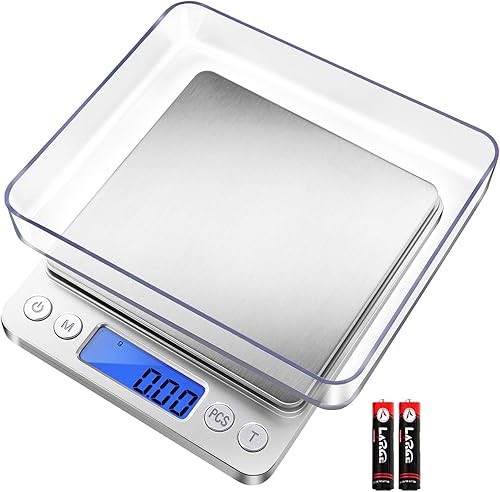
Fuzion Digital Gram Scale .01 Gram Accuracy: Best for counting and tare
- 500g x 0.01g
- 6 units
- PCS counting
- 2 trays included
A 500g gram scale with tare, counting mode and two trays for spices, coffee, yeast and small kitchen weights.
Pros
- 0.01g readability
- Counting mode
- Trays included
Cons
- 500g capacity limit
- No calibration weight named
The Fuzion PT500 suits small kitchen weights such as yeast, herbs, powder, spice, coffee and matcha. Its 500g x 0.01g readability helps under 20g.
Minimum weight is 0.03g, with permissible error plus or minus 0.02g. Tare subtracts container weight, and PCS counts identical items.
Six units include grams, ounces, grains, troy ounces, pennyweights and carats. Two plastic trays are included, plus 2 AAA batteries.
The stainless steel platform sits on a durable ABS base, which gives a stable surface for small trays. The backlit LCD helps you read results in low light.
Counting mode suits pills, beads or coins when items share a uniform weight. The scale ships pre-calibrated, and auto-off helps with battery life.
Trade-off: capacity stops at 500g and no calibration weight is named in the box. Keep a larger scale for flour and dough.
Cybergiant 13lb/0.1g Precision Digital Food Scale: Best for espresso and meal prep
- 13 lb/6 kg capacity
- 0.1g accuracy
- Removable stainless panel
- Backlit LCD
A 13 lb food scale with 0.1g steps for baking, espresso and meal prep, with tare and a removable stainless panel.
Pros
- High capacity
- 0.1g steps
- Removable panel
Cons
- No bowl included
- Battery powered
The Cybergiant suits baking, espresso, meal prep and portion weighing up to 13 lb. Its 0.1g accuracy and 13 lb/6 kg capacity balance small and large jobs.
Tare, a backlit LCD and a removable stainless panel help with containers and cleanup. Four units cover oz, lb, g and ml, and two AAA batteries are included.
The removable panel helps when flour or espresso grounds spill during weighing. You can lift the panel for washing, then replace it for the next batch.
Auto shut off helps save power, while the lightweight build makes it easy to move between a counter, classroom, office or lab. It also suits packages, mail, fruit and vegetables.
For espresso, 0.1g steps help you repeat dose weights with more control than a 1g scale. For meal prep, the higher capacity handles produce and containers without splitting the load.
Trade-off: no bowl is included, and 0.1g steps are coarser than 0.01g pocket models. It is strong for dough and portions, weaker for tiny yeast.
GDEALER Food Scale: Best for compact counters
- 500g x 0.01g
- 6 units
- Counting feature
- Stainless plate
A compact 500g food scale with 0.01g readability, tare and counting for baking, coffee and small ingredient weights.
Pros
- 0.01g readability
- Compact and light
- Counting feature
Cons
- Accuracy drops under 3g
- 500g capacity limit
The GDEALER suits compact counters and small baking weights up to 500g. Its 0.01g readability covers yeast, salt, coffee and spices.
The stainless plate and ABS frame are light and easy to clean. Tare gives net weight, and the counting feature suits uniform small items.
Six units include g, ct, dwt, ozt, oz and gn. Two transparent plastic cases can hold small items, and the blue backlit LCD helps at night.
The high sensitivity sensor is rated from 0.05g to 500g. That range makes it suitable for jewelry, medicine and cooking ingredients in small amounts.
Counting requires uniform items, with sample counts of 25, 50, 60, 75 or 100. Auto shut off helps when you forget to switch the scale off.
Trade-off: GDEALER notes accuracy may drop under 3g, and capacity stops at 500g. It is a budget pocket pick, not a milligram scale.
How to compare precision gram scales side by side
Readability decides the smallest useful weight. A 0.1g scale suits most dough salt and yeast.
A 0.01g scale suits spices and small yeast amounts.
A 0.001g scale suits sub-gram powder work.
Readability is only part of the story, because minimum weight sets the floor for reliable readings. A display that shows 0.01g steps may still give shaky results below its stated minimum.
| Product | Best for | Capacity | Readability | Units | Our score |
|---|---|---|---|---|---|
| Etekcity 0.1g Food Kitchen Scale | all-around baking | 11 lb/5 kg | 0.1g under 1000g, 1g above | oz, lb, g, fl oz, mL | 9.7 |
| Fuzion Digital Pocket Scale | pocket precision | 500g | 0.01g | 9.6 | |
| MAXUS Digital Milligram Scale 50g/0.001g | milligram weights | 50g | 0.001g | g, oz, ozt, dwt, ct, gn | 9.5 |
| GGQ Food Scale -33lb Digital Kitchen Scale | large batches | 33 lb/15 kg | 1g | g/kg/lb:oz/oz/ml | 9.2 |
| Weigh Gram Digital Milligram Scale 50g/0.001g High Precision | tiny powder amounts | 50g | 0.001g | g, oz, ozt, dwt, ct, gn | 9.1 |
| Toprime Digital Gram Scale 500g 0.01g Food | 500g food weighing | 500g | 0.01g | 8.8 | |
| Fuzion Digital Gram Scale .01 Gram Accuracy | counting and tare | 500g | 0.01g | 8.6 | |
| Cybergiant 13lb/0.1g Precision Digital Food Scale | espresso and meal prep | 13 lb/6 kg | 0.1g | oz, lb, g, ml | 8.4 |
| GDEALER Food Scale | compact counters | 500g | 0.01g | 8.1 |
Capacity decides the largest job. Pocket scales here stop at 50g or 500g.
Kitchen scales here reach 5kg, 6kg and 15kg. Check the bowl weight before you weigh dough in a container.
A heavy bowl can use much of a 500g pocket scale range before you add any food. That is why pocket scales work best with light trays and small dry ingredients.
Minimum weight and permissible error matter at the low end. Several 0.01g models start at 0.03g to 0.05g.
A milligram model helps when your formula uses under 2g.
Tare, units and auto-off affect daily use. Tare lets you add ingredients in one bowl.
Units let you switch between grams and ounces. Auto-off saves batteries between uses.
We looked at calibration parts because fine scales drift. Fuzion includes a 50g weight, MAXUS includes two 20g weights, and Weigh Gram includes one 20g weight.
For bowl-first weighing, see our best digital kitchen scale with bowl guide. It explains which bowl designs help with flour and dough.
Power, storage and included accessories
Included trays, covers and calibration weights can change daily use as much as the sensor. A tray helps with powder, a cover protects the pan, and a calibration weight supports repeat checks.
What readability do you need for yeast and salt?
Use 0.1g for most dough, 0.01g for small yeast and salt, and 0.001g for sub-gram amounts. A typical loaf may use 5g to 10g yeast, so 0.1g steps are enough for many bakers.
Salt often falls near 10g to 20g in dough. A 0.1g scale reads that well, while 0.01g gives a finer check for low-salt formulas.
Instant yeast in small test batches can fall under 3g. That is where 0.01g or 0.001g models earn their place.
0.1g kitchen scales
Choose 0.1g models such as Etekcity and Cybergiant for flour, dough and toppings. They read small additions well, but they are not milligram tools.
0.01g pocket scales
Choose 0.01g models such as Fuzion, Toprime and GDEALER for yeast, spices and coffee. Their 500g cap keeps them focused on small weights.
0.001g milligram scales
Choose MAXUS or Weigh Gram for powder and tiny amounts under 50g. They need a flat surface, warm-up time and calibration for best results.
How much capacity do you need for dough and bowls?
Choose 5kg or more if you weigh flour and dough in a bowl, and 500g if you weigh only small dry ingredients. A mixing bowl can weigh 500g to 1kg before you add flour.
The GGQ reaches 33 lb/15 kg, so it handles large batches and heavy bowls. The Etekcity reaches 11 lb/5 kg, which covers most home dough.
The Cybergiant reaches 13 lb/6 kg, which suits meal prep and baking. Pocket scales at 500g cannot hold a dough bowl, so use them for yeast and salt only.
Our Best Digital Kitchen Scale For Bread Baking guide shows how capacity and platform size affect bread work.
Platform size and bowl fit
A wider panel, such as the GGQ at 7.5 x 5.5 in, gives more room for large containers. A removable bowl helps when the platform sits under a bowl.
Tare for multi-ingredient dough
Tare subtracts the bowl, then each ingredient reads as a new weight. That workflow helps you add flour, water, salt and yeast in one bowl.
Storage in a small kitchen
A flip bowl, hanging hook or pocket size can decide where a scale lives after use. If it is easy to store, you are more likely to use it for every batch.
Can you measure grams with measuring cups?
Cups measure volume, while a scale measures mass, so cups can vary by how you scoop and level. A cup of flour can weigh less or more depending on packing.
If you want to convert, our measuring cups in grams guide explains the limits of volume measures. It also shows why mass is more repeatable for dough formulas.
For a broader look at cups and spoons, see measuring cups in our baking measuring tools guide. Use cups for quick checks, and a scale for repeatable batches.
When cups are still useful
Cups help with water, milk and quick liquid measures. A scale with ml or fl oz modes can also weigh liquids by mass.
When a scale wins
A scale wins for flour, yeast, salt and spices, because each gram is the same weight every time. That repeatability helps you match a formula you liked last time.
Which precision gram scale is best for bread baking?
For bread, pick a 5kg or larger 0.1g kitchen scale for dough, plus a 0.01g pocket scale for yeast and salt. That two-scale setup covers both jobs without compromise.
Our Best Kitchen Scale For Bread Baking For Precise Measuring guide focuses on dough workflow. It covers bowl tare, platform size and storage.
The Etekcity is the best single-scale choice here for bread because it weighs dough and reads small additions. The Fuzion pocket scale is the best add-on for yeast and salt.
Bread formulas are usually written as percentages, so small errors in salt or yeast can shift the whole batch. A fine pocket scale helps you stay close to the formula you chose.
For sourdough starters
Use a 0.01g or 0.001g scale for starter feeds under 50g. That fineness helps you repeat feed ratios and track small changes.
For enriched dough
Use a high-capacity scale for flour, milk, eggs and toppings. Tare the bowl once, then add ingredients in recipe order.
How do you set up and care for a precision gram scale?
Place the scale on a flat, stable surface, let it settle, tare the container, then add ingredients slowly. Drafts, vibration and a sloping counter can change fine readings.
Let a 0.01g or 0.001g scale warm up and settle before precise work. Keep it away from heat, steam and direct sun.
Calibrate with the included weight before important small weights. Fuzion, MAXUS and Weigh Gram include calibration weights in this group.
Clean the platform with a dry or slightly damp cloth, and keep powder out of seams. Store pocket scales in a cover or drawer when you are not using them.
Our best digital scale 0.01 gram accuracy guide covers setup for 0.01g models in more detail. It explains stable placement, tare and calibration checks.
Cleaning and storage habits
Wipe stainless platforms after flour or spice use, and dry them fully before storage. Keep pocket scales closed or covered so dust does not settle on the pan.
Verdict: which best precision gram scale should you buy?
Buy the Etekcity 0.1g Food Kitchen Scale if you want one scale for most baking. It weighs up to 11 lb, reads to 0.1g under 1000g and includes a removable bowl.
Buy the Fuzion Digital Pocket Scale if your main job is yeast, salt and spices under 500g. Its 0.01g steps and 50g calibration weight suit precise small weights.
Buy the MAXUS or Weigh Gram milligram scale if you need 0.001g readings under 50g. Those models are specialists, so pair one with a larger kitchen scale for flour and dough.
Buy the GGQ if you make large batches and need 33 lb capacity with rechargeable power. Its 1g steps make it less suited to tiny yeast weights, so add a pocket scale for small amounts.
Start with the Etekcity for daily baking, then add a 0.01g pocket scale when your formulas call for smaller weights. That pairing covers dough, yeast, salt and spices without forcing one scale to do every job.
Our top 3 picks at a glance
-
1
-
2
-
3
Best for milligram weights
MAXUS Digital Milligram Scale 50g/0.001g
9.5/10 our score
See it on Amazon
Frequently asked questions
What readability do bakers need for yeast and salt?
Most bakers do well with 0.1g readability for dough, and 0.01g for yeast, salt and spices under 20g. A 0.001g milligram scale helps when a formula uses under 2g and you need repeatable tiny weights.
Match readability to your smallest typical ingredient.
Can a kitchen scale replace measuring cups?
Yes, a scale weighs flour, sugar and liquids by mass, so volume varies less between bakers. Use tare to add ingredients in one bowl and read each new amount.
Measuring cups still help for quick dry or liquid checks, but mass is more repeatable.
Do precision scales need calibration?
Yes, pocket 0.01g and 0.001g scales should be checked with a calibration weight before precise work. Place the scale on a flat surface, let it settle, then follow the maker steps for your model.
Calibration weights are named in the box for several picks here.
What capacity should a precision gram scale have?
Choose 500g if most weights are yeast, salt, spices and coffee. Choose 5kg to 15kg if you also weigh flour, dough and mixing bowls.
Many bakers keep one large kitchen scale and one small pocket scale for different jobs.


