8 Best French Rolling Pins (November 2026)
The best French rolling pins include the Ultra Cuisine French Rolling Pin for Baking –15.75-inch for pastry that needs chilling, the muso wood Sapele French Rolling Pin for fondant and pie crust, and the ebuns French Rolling Pin for pizza and pasta dough.
On this page (10 sections)
- Our picks in detail: the best French rolling pins for control
- How the best French rolling pins compare side by side
- What makes a French rolling pin different from a standard rolling pin?
- Which size French rolling pin should you buy?
- Wood, stainless steel or marble: which material fits your dough?
- Does a French rolling pin with no handles suit beginners?
- How do you control thickness without rings or guides?
- How does a French rolling pin help with French bread and pizza dough?
- How should you clean and store a tapered rolling pin?
- Verdict: which French rolling pin should you buy?
The best French rolling pin is the one that lets you feel the dough, so a tapered pin with no handles is a strong first choice for pastry and pizza. Our top pick adds a chillable stainless body that suits butter dough.
The ratings below weigh size, weight, material and thickness control.
A French rolling pin has no handles and tapers at both ends, so you hold the barrel itself. That shape gives your hands direct feedback on thinning dough.
Our picks at a glance
-
1
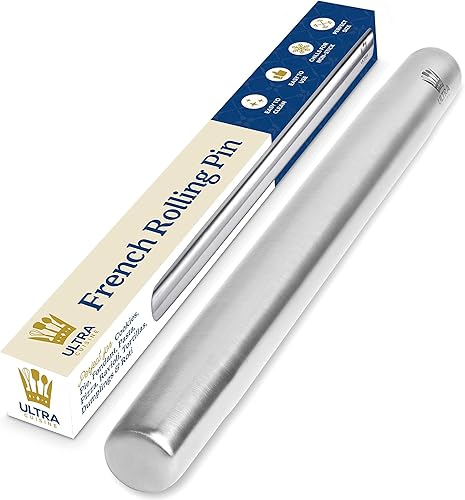 Best for pastry that needs chilling
Ultra Cuisine French Rolling Pin for Baking –15.75-inch
9.3/10 our score
See it on Amazon -
2
 Best for fondant and pie crust
muso wood Sapele French Rolling Pin
9.2/10 our score
See it on Amazon -
3

- 4
 Check it
J.K. Adams French Tapered Rolling Pin
Best for large pastry sheets - 5
 Best for even thickness without guessingCheck it
- 6
 Check it
muso wood Wooden Rolling Pin for Baking
Best for light everyday rolling - 7
 Check it
Koville African Natural Marble French Rolling Pin
Best for cool, heavy rolling - 8
 Check it
Erongoo Natural Marble Rolling Pin for Baking
Best for non-stick stone surface
Our picks in detail: the best French rolling pins for control
Each pin below suits a different dough and kitchen habit. Weight matters as much as length, because weight changes how hard you need to push.
Ultra Cuisine French Rolling Pin for Baking –15.75-inch: Best for pastry that needs chilling
- 15.75 in long x 1.5 in diameter
- 10 oz stainless steel
- Handle-free tapered design
- Dishwasher safe and freezable
A light, chillable stainless pin that suits butter pastry and beginners who want simple cleanup.
Pros
- Dishwasher safe
- Can be frozen for cool dough
- Light at 10 oz
Cons
- You set the pressure with your hands
- No thickness rings
The Ultra Cuisine pin suits bakers who make butter pastry, pie crust and pizza dough and want fast cleanup. It is 15.75 in long, 1.5 in in diameter and weighs 10 oz, so it is light enough to guide with your hands.
Its stainless body can go in the freezer, which helps when butter in the dough starts to warm. A chilled pin keeps the dough firmer for longer, and the brushed surface holds a light dusting of flour.
The center tapers from 1.5 in to 1.25 in at the ends, so the full barrel can roll wide dough without leaving lines at the edges. You set the pressure with your hands, not with the weight of the pin.
That light weight is also the trade-off. Very wet dough still needs a floured pin and a floured work surface.
If you prefer not to push, a heavier marble pin may suit you better.
Cleanup is simple because the pin is one stainless rod with no parts to assemble. You can wash it by hand and towel dry, or place it in the dishwasher.
muso wood Sapele French Rolling Pin: Best for fondant and pie crust
- 15.7 in solid sapele wood
- Hand-sanded finish
- Tapered ends
- 9.92 oz
A smooth sapele wood pin for pie crust, fondant and cookies, with a warm wood feel.
Pros
- Smooth hand-sanded surface
- Light for everyday use
- Tapered ends for control
Cons
- Needs gentle hand cleaning
- No fixed thickness settings
The muso wood Sapele pin suits bakers who like the feel of wood for pie crust, fondant and cookies. It is 15.7 in long, 1.34 in wide and weighs 9.92 oz, so it stays easy to move across a counter.
The surface is hand-sanded three times, which gives a smooth finish for delicate dough. Natural wood knots do not break the finish, so fondant and pastry can slide without catching.
The tapered ends let you steer the pin from the center outward. That control helps you keep pie crust round instead of stretching one side more than the other.
The trade-off is care. You rinse it with water or wipe it with a damp cloth, then let it air dry.
It does not go in the dishwasher.
ebuns French Rolling Pin: Best for pizza and pasta dough
- 18 in rubberwood
- Handle-free tapered design
- 10.4 oz
- Smooth surface resists sticking
An 18-inch wood pin that gives extra reach for pizza bases, pie crusts and pasta.
Pros
- Longer 18 in barrel
- Even pressure with no handles
- Easy to store or hang
Cons
- Wipe clean care
- No thickness guides
The ebuns pin suits bakers who roll pizza dough, pie crust, cookies and pasta and want more length than a standard 15 in pin. It is 18 in long and weighs 10.4 oz, so it covers more dough in each pass.
The handle-free design gives even pressure across the barrel. With no handles to grip, you hold the tapered ends and guide the pin with both hands.
Rubberwood gives a smooth surface that resists sticking. A light dusting of flour still helps with wet dough, but the surface releases dough more easily than a rough finish.
The extra length helps when you roll a pizza base from the center out. A rolling pin and mat set can make it easier to roll pizza dough on a consistent work surface.
You need fewer strokes, so the dough stays more even and you spend less time repositioning it.
The trade-off is storage. An 18 in pin needs a drawer or a hook that fits it.
You wipe it clean with a damp cloth, and the slim shape stores flat.
J.K. Adams French Tapered Rolling Pin: Best for large pastry sheets
- 20.5 x 1.75 in maple
- 14.4 oz
- Slightly textured surface
- Hand wash and oil care
The longest pin here, a maple dowel for large sheets and delicate pastry.
Pros
- Longest barrel at 20.5 in
- Textured maple holds flour
- Smooth pivot control
Cons
- Needs hand washing and oiling
- Heaviest wood pin here
The J.K. Adams pin suits bakers who roll large sheets of pastry and want smooth pivot control.
It is 20.5 in long, 1.75 in wide and weighs 14.4 oz, making it the longest and heaviest wood pin here.
The maple surface is slightly textured, so it holds a fine dusting of flour well. That helps prevent sticky dough from tearing during long rolling sessions.
The tapered dowel shape lets you pivot the pin across the counter. You can turn the dough a quarter turn and roll again without lifting your hands from the barrel.
The extra length and diameter suit wide pie crusts and large pastry sheets. Smaller cookies still work, but you may find the pin harder to steer on small dough.
The trade-off is care and weight. J.K.
Adams says to hand wash it gently and condition it with food-safe mineral oil. At 14.4 oz, it needs more arm control than the lighter pins.
Joseph Joseph PrecisionPin: Best for even thickness without guessing
- Beech wood, 16.54 in
- Five sets of removable rings
- About 2 mm to 10 mm thicknesses
- Usable without rings
A beech pin with removable rings that set pastry thickness for biscuits and pizza bases.
Pros
- Set thicknesses from about 2 mm to 10 mm
- Works without rings
- Twist rings off to change size
Cons
- More parts to store
- Rings add width to handle
The Joseph Joseph PrecisionPin suits bakers who struggle to keep pastry the same thickness from edge to edge. It is a beech wood pin, 16.54 in long, with five sets of removable rings.
The rings set thickness at about 2 mm, 4 mm, 6 mm, 8 mm or 10 mm. You twist off the rings you do not need, roll, and the pin stops at the thickness you chose.
That system helps with biscuit dough, pizza bases and pastry sheets. Each sheet comes out more uniform, so biscuits bake more evenly and pizza crusts cook at the same rate.
You can also use the pin without any rings as a conventional rolling pin. That gives you a thin roll for dough that needs to go below 2 mm.
The trade-off is parts. The pin comes with 10 removable rings, so you need a place to store them.
The rings also change how the pin feels compared with a plain tapered dowel.
muso wood Wooden Rolling Pin for Baking: Best for light everyday rolling
- 15.75 in walnut wood
- 8.48 oz
- Tapered ends
- Polished and treated with mineral oil
The lightest pin here, a walnut tapered pin for pie crust, cookies and fondant.
Pros
- Lightest at 8.48 oz
- Smooth polished surface
- Easy 15.75 in storage size
Cons
- Wood care needed
- No guides for thickness
The muso wood Walnut pin suits bakers who want the lightest option here for everyday rolling. It is 15.75 in long and weighs 8.48 oz, so it moves with very little effort.
The walnut surface is polished three times and treated with mineral oil three times. That finish feels smooth and does not stick to dough, which helps with pie crust and cookies.
Both ends taper, so you can hold the pin near the ends for fine control. You can change thickness by changing your pressure, with no guide rings to adjust.
The 15.75 in size stores easily in a drawer. The rich brown grain also makes it a pin you may want to leave out on the counter.
The trade-off is that light weight gives you less help from gravity. Thick bread dough and firm cookie dough will need more hand pressure than with a marble pin.
Koville African Natural Marble French Rolling Pin: Best for cool, heavy rolling
- 16 in marble
- Heavy stone body
- Smooth non-stick surface
- Wooden resting base
A marble pin with a wooden base that stays cool and flattens dough with its own weight.
Pros
- Naturally cool surface
- Heavy body does the work
- Wooden resting base included
Cons
- Heavier to lift and store
- Each piece has a unique pattern
The Koville marble pin suits bakers who want a heavy pin that flattens dough with light hand pressure. It is 16 in long and made from African natural marble.
The stone stays cool while you roll, which helps keep butter firm in pastry. The smooth surface is non-stick, so dough releases without heavy flouring.
The weight does much of the work. You guide the pin more than you push it, which can reduce hand fatigue during longer sessions with pizza dough or bread dough.
Each piece is unique because the marble veining differs from piece to piece. That makes it a strong gift, since no two pins look the same.
The trade-off is handling and storage. Marble is heavy and hard, so you need a safe place to rest it.
The pin comes with a wooden resting base, which keeps it from rolling across the counter.
Erongoo Natural Marble Rolling Pin for Baking: Best for non-stick stone surface
- 15.6 in green marble
- 2.7 lb weight
- 1.48 in maximum diameter
- Wooden storage base and phone stand
A weighted green marble pin that keeps butter pastry cool and wipes clean.
Pros
- 2.7 lb weight flattens with light pressure
- Cool non-porous surface
- Wooden base included
Cons
- Heavy at 2.7 lb
- Needs careful storage
The Erongoo marble pin suits bakers who want a cool, non-stick surface with real weight behind it. It is 15.6 in long, with a 1.48 in maximum diameter and a weight of 2.7 lb.
The polished green marble surface is non-porous, so it resists dough buildup and wipes clean with a damp cloth. The cool surface also keeps butter, pastry and fondant chilled while you work.
The tapered barrel gives a comfortable grip and flexible thickness control. The weight flattens dough with gentle pressure, which eases fatigue during longer baking sessions.
The pin suits fondant, cookie dough, bread, pizza crust and pie crust. A wider barrel covers more dough in each pass than a short dowel.
The trade-off is the 2.7 lb weight. That weight helps with firm dough, but it takes more care to lift and set down.
The included wooden base holds the pin and flips over to serve as a phone stand.
How the best French rolling pins compare side by side
The table below puts size, material and weight in one place so you can spot the gaps fast. The lightest pin is the muso wood Walnut at 8.48 oz, and the heaviest is the Erongoo marble at 2.7 lb.
| Product | Best for | Size | Material | Weight | Our score |
|---|---|---|---|---|---|
| Ultra Cuisine French Rolling Pin for Baking –15.75-inch | pastry that needs chilling | 15.75 x 1.5 in | Stainless Steel | 10.08 oz | 9.3 |
| muso wood Sapele French Rolling Pin | fondant and pie crust | 15.7 x 1.34 in | Sapele Wood | 9.92 oz | 9.2 |
| ebuns French Rolling Pin | pizza and pasta dough | 18 in long | Rubberwood | 10.4 oz | 9.1 |
| J.K. Adams French Tapered Rolling Pin | large pastry sheets | 20.5 x 1.75 in | Maple Wood | 14.4 oz | 9.0 |
| Joseph Joseph PrecisionPin | even thickness without guessing | 16.54 x 2.52 in | Wood | 0.42 kg | 9.0 |
| muso wood Wooden Rolling Pin for Baking | light everyday rolling | 15.75 in long | Walnut | 8.48 oz | 8.8 |
| Koville African Natural Marble French Rolling Pin | cool, heavy rolling | 16 in long | Marble | Heavy stone body | 8.4 |
| Erongoo Natural Marble Rolling Pin for Baking | non-stick stone surface | 15.6 x 1.48 in | Marble | 2.7 lb | 8.2 |
We compared the eight pins by length, diameter, weight and material. Length decides how much dough you cover per pass, and weight decides how much pressure your hands must supply.
We also checked cleaning and included parts. Stainless steel can go in the dishwasher, wood needs hand care, and marble needs a safe resting spot.
Our score weighs specs and buyer feedback against what you are shopping for. A pin scores higher when its size and material fit the dough you roll most often.
What makes a French rolling pin different from a standard rolling pin?
A French rolling pin has no handles, so you hold the barrel directly with both hands. That contact gives you more feel for the dough as it thins.
A standard pin has handles at each end, so your hands hold the handles and the barrel rolls below. That design is easier for heavy dough, but gives less direct feedback.
The tapered shape also helps you steer from the center out. You can turn the dough without lifting the pin for long.
If you are still deciding, our guide to which type of rolling pin is best walks through handles, tapers and rings.
Why no handles can help with pastry
Pastry tears when you push too hard in one spot. With no handles, your hands sit on the barrel, so you feel resistance sooner.
That feel helps with pie crust, fondant and thin pizza dough. You can ease off before the dough stretches too thin.
When handles might still suit you better
Handles help with firm bread dough and large batches of cookies. Your arms do more of the work, and the pin stays stable.
A handled pin is also easier if you have limited hand strength. You grip fixed handles instead of holding a round barrel.
Which size French rolling pin should you buy?
Choose 15 to 16 in if you roll pie crust, cookies and small pizza bases. That size fits most drawers and is easy to steer.
Choose 18 to 20 in if you roll large pizza bases, wide pie crusts or pasta sheets. A longer barrel covers more dough per pass.
The J.K. Adams pin at 20.5 in is the longest here, while the ebuns pin at 18 in is the middle option.
Both suit large sheets better than the 15.75 in pins.
If you want a longer barrel for wide dough, our best rolling pin long guide compares long pins by diameter and weight.
Diameter matters as much as length
A wider diameter, like 1.75 in on the J.K. Adams pin, rolls over dough with fewer turns.
A narrower pin, like 1.34 in on the sapele pin, gives finer control on small pieces.
Think about your largest dough, not your smallest. A pin that is too short for a wide pizza base will leave uneven edges.
Storage space sets a real limit
Measure your drawer before you buy an 18 in or 20.5 in pin. A long pin that does not fit will end up stored in a less handy spot.
The marble pins also need a resting base or a safe counter spot. A heavy pin stored loose can roll and hit other items.
Wood, stainless steel or marble: which material fits your dough?
Wood suits most bakers because it holds flour well and feels warm in the hands. Maple, sapele, walnut and rubberwood all appear in this group.
Stainless steel suits bakers who want easy cleanup and a chillable pin. The Ultra Cuisine pin can go in the dishwasher and in the freezer.
Marble suits bakers who want weight and a cool surface. Both marble pins here stay cool and flatten firm dough with less pushing.
Wood pins for flour grip and light weight
Wood holds a dusting of flour, which helps sticky dough release as you roll. Wood pins are also lighter, so they are easy to steer.
The trade-off is care. Wood pins need hand washing and air drying, and some need oiling to stay smooth.
Stainless steel for chilling and cleanup
A stainless pin can be frozen before you roll butter pastry. That keeps the butter firm while the dough thins.
Stainless also does not dry out, splinter or crack. You wash it by hand or in the dishwasher and towel dry it.
Marble for weight and a cool surface
Marble gives you weight without extra pushing. That helps with firm cookie dough and bread dough.
The cool stone surface also helps with fondant and butter pastry. You do need a base or a safe spot to rest a heavy pin.
Does a French rolling pin with no handles suit beginners?
Yes, a French rolling pin suits beginners if you start with a light pin and a simple dough. The Ultra Cuisine pin is one rod with no parts to assemble, so there is nothing to set up wrong.
Start with pie crust or cookies, then move to pizza dough. Those doughs give clear feedback, so you learn how much pressure thins the dough.
Use a light dusting of flour on the pin and the counter at first. That helps the dough release while you learn the feel of the tapered barrel.
If you prefer fixed handles while you learn, our best rolling pin with handles guide covers that style.
How to hold a tapered pin for best control
Hold the barrel with both hands, one near each end. Keep your palms flat and your fingers spread.
Roll from the center out, then turn the dough a quarter turn. That pattern keeps the shape round and the thickness even.
Common beginner mistakes with a tapered pin
Pressing hard with the center of the pin can thin one spot too fast. Lighter passes with more turns give a more even sheet.
Rolling only in one direction can stretch the dough into an oval. Turn the dough often, and check the thickness as you go.
How do you control thickness without rings or guides?
You control thickness with pressure, turns and checks. That is the core skill behind a French rolling pin, and it takes a little practice.
Roll a few passes, lift the dough, turn it, and roll again. Check the thickness with your fingers or by holding it up to the light.
If you want set thickness, choose a pin with rings. The Joseph Joseph PrecisionPin offers about 2 mm to 10 mm.
Our best adjustable rolling pin guide covers pins that set thickness in other ways.
Measuring dough instead of guessing
Use measuring cups to keep the dough amount the same each time. A consistent amount of dough makes thickness easier to judge.
Weighing or measuring flour the same way also helps, because wet dough rolls differently from dry dough.
When rings are worth the extra parts
Rings help when you need biscuits or pizza bases at a set thickness. They remove guesswork from each sheet.
Plain tapered pins help when you want the most control on delicate pastry. You feel the dough and stop before it tears.
How does a French rolling pin help with French bread and pizza dough?
A French rolling pin helps shape pizza dough and bread dough into flat, even rounds. The taper lets you roll from the center out without pushing the dough to one side.
For pizza, roll the dough into a round, then lift and stretch it gently by hand. The pin does the first flattening, and your hands finish the crust.
For bread dough, a pin can flatten a rectangle before you roll it into a loaf. That helps you press out air bubbles and get a tighter roll.
If you bake French bread at home, our Best Bread Maker For French Bread guide pairs a machine with hand shaping. Our How To Make French Bread In A Bread Maker? guide also covers dough handling after the machine finishes.
Shaping pizza dough with a tapered pin
Roll the dough into a round of even thickness, then turn and roll again. Keep the edges a little thicker if you want a raised crust.
Check for tears as you roll, and patch them with a small piece of dough. A light flour dusting helps the pin glide.
Flattening bread dough before shaping
Roll the dough into a rectangle, then roll it up from the short end. Press the seam closed so the loaf holds its shape in the pan.
A pin also helps you flatten dough for flatbreads. Those doughs need thin, even sheets, which a tapered pin handles well.
How should you clean and store a tapered rolling pin?
Clean wood pins with water or a damp cloth, then air dry them. Do not soak wood pins or put them in the dishwasher.
Clean stainless steel by hand or in the dishwasher. Towel dry it after washing to keep the brushed finish even.
Wipe marble pins with a damp cloth after use. Store marble on its wooden base so it does not roll or hit other items.
Oiling and care for wood pins
Some wood pins need food-safe mineral oil once in a while. That keeps the surface smooth and helps prevent cracks.
Check the wood for dry spots or rough patches. A light oiling after hand washing keeps the finish in good shape.
Storing heavy pins safely
Store marble pins on a base or in a drawer where they cannot roll. A heavy pin that falls can chip stone or dent other items.
Light wood and stainless pins can hang on a hook or rest in a drawer. Make sure the space fits the full length before you store them.
Verdict: which French rolling pin should you buy?
Pick the Ultra Cuisine pin if you want a light, chillable pin with easy cleanup for pastry and pizza. It is our top pick for most bakers because it balances control, weight and care.
Pick the Joseph Joseph PrecisionPin if you want set thickness for biscuits and pizza bases. Pick a marble pin if you want weight and a cool surface for firm dough.
Pick the J.K. Adams pin if you roll large pastry sheets and do not mind hand washing and oiling.
Pick the muso wood Walnut pin if you want the lightest option for everyday rolling.
The best French rolling pin for you is the one that fits your dough, your drawer and your cleanup habit. Choose by material first, then by length, and you will roll dough with more control from the first sheet.
Our top 3 picks at a glance
-
1
Best for pastry that needs chilling
Ultra Cuisine French Rolling Pin for Baking –15.75-inch
9.3/10 our score
See it on Amazon -
2
Best for fondant and pie crust
muso wood Sapele French Rolling Pin
9.2/10 our score
See it on Amazon -
3


