How to Choose Measuring Cups for Dry and Liquid Ingredients
Use dry measuring cups for flour and other scoopable solids, and liquid measuring cups for water, milk, oil and other pourable ingredients. The right design helps you read the amount and transfer ingredients with less mess.
On this page (11 sections)
- What is the difference between dry and liquid measuring cups?
- How should you measure dry ingredients?
- How should you measure liquid ingredients?
- Which cup designs make liquid measuring easier?
- When is a multi-size liquid cup set useful?
- Is glass useful for both measuring and mixing?
- Should you choose plastic or glass measuring cups?
- Which measuring cup size should you buy?
- How do you read the markings correctly?
- More guides on this topic
- How should you clean and store measuring cups?
Use dry measuring cups for flour and other scoopable solids, and liquid measuring cups for water, milk, oil and other pourable ingredients. The distinction matters because each style lets you handle the ingredient in a practical way.
Dry cups are filled to the top and leveled with a straight edge. This helps you get a flat, repeatable amount of flour, sugar or oats without packing the ingredient down.
Liquid cups leave space above the marked lines. That extra room helps you carry the cup to a bowl or pan without sloshing liquid over the side.
A spout is also common on liquid cups. It guides the flow into a narrow opening and makes the transfer cleaner.
The best choice depends on the ingredient and on how you like to read the amount. Some cooks prefer a side marking at eye level, while others prefer to look down into the cup.
For a broader look at kitchen tools, see our measuring cups guide.
What is the difference between dry and liquid measuring cups?
Dry measuring cups are made for filling to a level top, while liquid measuring cups are made for reading a line below the rim. The two designs measure the same volume, but they support different ways of handling ingredients.
Dry cups usually have a flat rim. You can scoop flour or sugar, then sweep across the top with a straight edge to remove the excess.
Sets often include several separate cups for common amounts.
Liquid cups usually have a pouring spout and visible markings on the side. The extra space above the marks helps prevent spills when you carry the cup or pour into a bowl.
The shape also affects how easily you can check the amount. A narrow cup may be harder to read from above, while an angled interior can place the markings in your line of sight.
How should you measure dry ingredients?
Fill a dry measuring cup according to the ingredient's instructions, then level the top without packing unless the recipe tells you to do so. For flour, spooning it into the cup and leveling it can help avoid adding extra flour through heavy scooping.
Keep the cup steady over a bowl or work surface. If the ingredient is packed, such as brown sugar in some recipes, follow the recipe's wording rather than using the same method as flour.
Dry cups are useful for:
- Flour and bread flour
- Granulated sugar
- Brown sugar
- Oats
- Rice and grains
- Chocolate chips
- Chopped nuts
For bread-machine recipes, measuring the ingredients in the order and form the recipe gives you matters. Read our guides on what ingredients you need for a bread maker and whether wet or dry ingredients go first in a bread maker.
How should you measure liquid ingredients?
Set a liquid measuring cup on a flat surface before you start pouring. This gives you a stable base and makes the liquid line easier to judge.
Pour slowly until the liquid reaches the needed mark. Pause near the line so you can check the level before adding more.
Do not hold the cup in the air while reading it, because the liquid can sit at an angle and make the mark harder to judge. Resting the cup on the counter keeps the surface level.
Use a spout when transferring water, milk, oil or melted butter. A controlled spout helps the liquid enter a bowl or pan in a steady stream.
Leave space above the liquid so you can move the cup without sloshing. Filling right to the rim may look precise, but it makes carrying the cup much riskier.
Liquid cups are useful for:
- Water
- Milk
- Cream
- Cooking oil
- Melted butter
- Broth
- Vinegar
For very small amounts, measuring spoons may be easier than a large cup. A large vessel can make a teaspoon or tablespoon amount harder to see.
For larger amounts, a 2-cup or 4-cup vessel can reduce the number of pours. Matching the cup to the amount also lowers the chance of overfilling.
When you measure several liquids in one recipe, set each cup down after pouring. This keeps the work area clear and helps you keep track of what has been added.
Which cup designs make liquid measuring easier?
An angled interior marking can let you read the amount from above instead of bending down to the side of the cup. This design is useful when you measure several liquids during one recipe.
The De'Longhi OXO Good Grips Angled Measuring Cup suits cooks who want one clear 2-cup cup for baking and cooking. It is a single size, so it works best when your usual liquid amounts fit comfortably within 2 cups.
Its angled surface is designed for reading from above. You do not need to bend down or lift the cup to eye level to check the amount.
This view can be helpful when the counter space is busy. You can look down into the cup while it rests on the surface and still see the marking.
The cup has standard and metric measurement markings. That gives you more flexibility when a recipe uses cups, ounces or milliliters.
The 2-cup size works well for common liquid portions without taking up as much space as a larger vessel. It is a practical middle ground for everyday measuring.
The plastic body is BPA free, which may matter if you prefer to avoid that type of plastic in food contact tools. The clear body also lets you see the liquid as you pour.
The soft, non slip handle is made for a steadier grip when you pour. That can help when your hands are wet or when you are moving the cup to a bowl.
The generous spout supports controlled pouring. It helps direct milk, water or oil without a wide, splashy flow.
The cup is dishwasher safe, which simplifies cleanup after baking or cooking. You can place it on the top rack and let the machine handle oily residue.
One cup like this suits a smaller kitchen or a cook who measures mostly modest amounts. If you often need larger volumes, you may still want a bigger cup alongside it.
When is a multi-size liquid cup set useful?
A multi-size set helps when recipes use different liquid amounts and you want to avoid repeated measuring. Smaller cups suit modest quantities, while a larger cup gives you more room for broth, water or other ingredients.
The OXO Good Grips Angled Measuring Cups suit a kitchen that measures both small and large liquid portions. The set includes 1-cup, 2-cup and 4-cup sizes, so you can match the vessel to the amount instead of filling a small cup several times.
The angled markings are designed to be read from above. The cups use Tritan Renew, which contains 50% certified recycled content through a mass balance allocation process, and the set is BPA free.
A multi-size set takes more storage space than one cup. It can still be a practical choice if you regularly bake, cook sauces or prepare recipes with several liquid measurements.
Compare more options in our best liquid measuring cups guide.
Is glass useful for both measuring and mixing?
Glass can be useful when you want to measure, mix or heat an ingredient in the same cup. Pyrex describes its glass cups as microwave, freezer, dishwasher and preheated-oven safe, which supports several kitchen tasks.
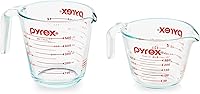
The Pyrex Essentials set suits cooks who want 1-cup, 2-cup and 4-cup sizes in glass. Its large markings are designed for quick reading, while the curved spouts help guide liquids into a bowl or pan.
The non-porous glass is BPA free and does not absorb food odors, flavors or stains. The cups can also be used for baking, cooking and mixing, giving you more ways to use them beyond measuring.
Glass is heavier than plastic, so consider how you will lift the largest cup when it is full. The 4-cup size is 8 in in diameter and 6 in high, while the 1-cup cup is 6 in in diameter and 4.5 in high.
Should you choose plastic or glass measuring cups?
Choose plastic if you want a lighter cup with markings designed for reading from above. Choose glass if you want a cup for measuring and heating ingredients, and you are comfortable with more weight.
The plastic choices here focus on angled markings, grips and easy pouring. The De'Longhi OXO cup gives you one 2-cup option, while the OXO set adds 1-cup, 2-cup and 4-cup sizes.
The Pyrex set gives you the same 1-cup, 2-cup and 4-cup range in glass. Its stated microwave, freezer, dishwasher and preheated-oven safe design can help when a recipe moves from measuring to heating.
Think about storage as well as material. One cup takes less cabinet space, while a set gives you more size choices but needs room for several vessels.
A measuring cup organizer can help keep a set accessible in a cabinet or drawer.
If storage is your main concern, see our guide to measuring cups with lids.
Which measuring cup size should you buy?
Choose a 1-cup cup for small liquid amounts, a 2-cup cup for everyday cooking, and a 4-cup cup for larger batches. A set makes sense when your recipes often move between these sizes.
A 1-cup cup is easier to handle for small amounts of milk, oil or melted butter. A 2-cup cup gives you more room for common baking and cooking tasks without becoming overly large.
A 4-cup cup suits larger liquid portions, but it needs more storage space and can be heavier when full. Check the handle, spout and cabinet space before choosing the largest size.
For a compact liquid option, compare our best small liquid measuring cup. If you prefer lightweight material, our best plastic liquid measuring cup guide covers that category.
How do you read the markings correctly?
Read the marking at eye level for a standard side-marked cup. This position helps you see the actual liquid surface without distortion from looking down at an angle.
For an angled cup, look down into the vessel and use the interior marking as designed. The angled surface places the reading line in your line of sight while the cup stays on the counter.
The liquid should meet the intended line without relying on the rim as a guide. The rim is only the edge of the cup, and it does not tell you the volume.
Check whether the cup uses cups, fluid ounces, milliliters or more than one system. Some cups carry several scales, so it helps to find the one your recipe needs before you pour.
Multiple markings can help when a recipe uses metric measurements. You can switch scales without converting the amount yourself.
If the lines are close together, pour in small amounts near the target. This gives you time to stop at the right mark instead of adding extra liquid.
Wipe any drips from the outside of the cup before you read it. Drops on the side can make the lines harder to see and can confuse your reading.
Lighting can also affect readability. A clear cup placed against a plain surface often makes the liquid line easier to spot.
Read our guide on how to read a measuring cup if the lines or units are unfamiliar. Understanding the scale will make each measuring task faster.
A clear marking system is more useful than a cup with a large capacity that is difficult to judge. Accuracy comes from the readability of the lines, not from the size alone.
More guides on this topic
- Best One-Cup Glass Measuring Cups
- Best Glass Measuring Cups
These guides suit readers who want glass options in different sizes. They can help you compare a single small cup with a full set for everyday baking.
How should you clean and store measuring cups?
Follow the care instructions for the material and keep the markings visible. The plastic options here are dishwasher safe, while the Pyrex set is described as dishwasher safe as well.
Rinse oily ingredients soon after use so residue does not build around the markings or handle. A quick rinse makes later washing easier and helps protect the printed lines.
Let the cup dry before nesting it with other cups. Trapped moisture can leave spots and make the interior feel stale.
Store glass cups where they will not knock against heavy cookware. Glass is sturdy, but a hard knock can chip the rim or crack the cup.
Keep plastic cups away from sharp tools that could scratch the surface. Scratches can make the markings harder to read over time.
Place measuring cups where you can take them out without moving other items. Easy access makes you more likely to use the right cup for each ingredient.
If you nest cups, check that the handles and spouts do not press against the markings. Gentle stacking protects the printed scales from wear.
Wash cups promptly after use with milk, oil or melted butter. This prevents odors and greasy films from building up on the handle.
The right measuring cups for dry and liquid ingredients depend on your recipes. Pick a flat-rim dry cup for flour and sugar, choose an angled plastic cup for quick liquid reading, or select a glass set if microwave and oven use matter to you.
Frequently asked questions
What is the difference between dry and liquid measuring cups?
Dry measuring cups are filled to the top and leveled for ingredients such as flour, sugar and oats. Liquid measuring cups usually have extra space above the measurement marks, plus a spout for pouring.
This design lets you fill and move liquids with less spilling.
Can I use a liquid measuring cup for dry ingredients?
You can use a liquid measuring cup for dry ingredients in a pinch, but it is harder to level the amount accurately. A dry cup gives you a flat rim for sweeping away extra flour, sugar or other scoopable ingredients.
Are glass or plastic measuring cups better?
Glass measuring cups can suit cooks who want a cup that is microwave, freezer, dishwasher and preheated-oven safe, as Pyrex describes its set. Plastic cups are lighter, and some have angled markings that let you read the amount from above.
How do I choose measuring cups for baking?
Choose dry measuring cups for flour, sugar and similar ingredients, then add a liquid cup with clear markings for milk, water and oil. If you often measure several liquid amounts, a set with 1-cup, 2-cup and 4-cup sizes can reduce repeated pours.